|
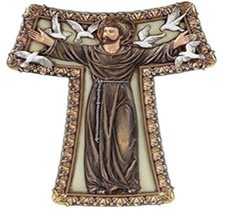
The Life of St. Francis of Assisi There are few saints who have such widespread popularity as Francis. His simple, absolute devotion to the Gospel and to poverty has indelibly shaped Christian spirituality, and his work to renew the church has borne fruit far beyond the limits of his life on earth. Francis had dreams of becoming a knight on the battlefield. Around 1202, Francis was part of a military campaign against the neighboring city-state of Perugia and was taken captive. In their prison, he ended up a broken and disillusioned young man. It was after his return from prison, and during the recovery that followed, that Francis’ life was changed. He began to reconcile his ideals of winning honor and glory in battle with a deeply-felt call to give away everything he had in order to follow Christ. When Francis took up with his friends again, he was noticeably distracted and distant. People would remark that Francis must be very deeply in love. “Yes,” he would reply, “I am going to take a wife more beautiful and worthy than any you know.” FAITH.ND Saint Francis of Assisi had a fear and abhorrence of lepers. One day, however, he met a man afflicted with leprosy while riding his horse near Assisi. Though the sight of the leper filled him with horror and disgust, Francis got off his horse and kissed the leper. Then the leper put out his hand, hoping to receive something. Out of compassion, Francis gave money to the leper. But when Francis mounted his horse again and looked all around, he could not see the leper anywhere. It dawned on him that it was Jesus whom he had just kissed. Francis’ embrace of the leper was not an isolated instance. No, his ministry to lepers would only expand. Francis would go down to the colony of lepers two miles below Assisi, outside the city walls. Francis and other friars continued to minister to the lepers, feeding them, while also caring for and kissing their wounds. This became an ongoing ministry for Francis and the friars. What Saint Francis Learned. In his Testament, Francis wrote, “When I was in sin, the sight of lepers nauseated me beyond measure; but then God himself led me into their company, and I had pity on them. When I became acquainted with them, what had previously nauseated me became the source of spiritual and physical consolation for me. After that I did not wait long before leaving the world.” Franciscan Media Who are the Lepers in your Life? Who do you need to embrace? While praying at a church outside of Assisi called San Damiano, Francis heard a voice coming from the crucifix, saying, “Francis, go and repair my house, which you see is falling down.” Francis thought Christ was ordering him to repair the dilapidated church building around him. Obediently, Francis began to collect funds to repair the church building, took a horse and cart, and loaded it with rich cloth from his father’s warehouse. He sold the entire cartful of cloth, as well as the cart and horse that carried them, and gave the money to the poor priest who was living at San Damiano. Pietro di Bernadone was outraged and forcefully retrieved Francis from the dilapidated church. Pietro beat Francis and put him in chains, demanding that Francis either stay at home or renounce his inheritance and pay back what he had taken. Francis was quite ready to forfeit his own inheritance, but he insisted that the money he had gathered from selling the cloth belonged to God and the poor. Frustrated with his stubborn son, Pietro brought Francis to an audience with the bishop of Assisi in the piazza of the town, and the bishop agreed that Francis must return the money to his father. Francis obeyed the Bishop and in typical Francis-fashion, went the extra mile. He insisted that he would return everything to his father, and, in front of the crowd gathered in the piazza, Francis stripped off all his clothing. Standing naked in front of the crowd, Francis turned to Pietro: “Up until now I have called you father here on earth, but now I say, '‘Our Father, who art in heaven.’' Pietro was both furious and full of sorrow; he turned and left the square with a heavy heart. A man who worked for the bishop gave Francis a simple frock; Francis marked it with the sign of the cross in chalk, and this became his first habit. Francis began to travel around the countryside like a troubadour. Possessing nothing, Francis relied solely on the generosity of others for food, clothing, and shelter. Eventually, Francis returned to Assisi and began to rebuild the church of San Damiano himself. He begged for money in the streets of Assisi and hauled stones from a nearby quarry by himself. He went about repairing several other churches in the region until he heard one day a reading from the Gospel of Matthew, in which Jesus sends the disciples to preach the kingdom of God without shoes or staff. Following the commands of the Gospel wholeheartedly, Francis took off his shoes, gave away the few clothes he wore, and started preaching repentance. Very quickly, his passionate words and remarkable example touched the hearts of people he encountered, and soon other young men started to join his way of life. As their small society began to grow, Francis made simplicity the foundational rule of his order. In 1209, when Francis drew up the first simple rule, he enjoined the friars to, in their every action, display their love for poverty - from what they wore to the food they ate. One year later, after Francis convinced Pope Innocent III to grant their eclectic band of mendicants the church’s approval, the Franciscan Order was officially born. And, of course, Francis’ love of and gentle command over animals is legendary. Once, when preaching, Francis commanded the birds to be quiet and they flocked around him to listen. Various stories have circulated of his befriending a rabbit and his taming of a wolf that plagued the city of Gubbio. Francis and the first men who became the Franciscans worked for their daily bread by laboring in the field. When this supply of food was not enough to provide what they needed, they begged door-to-door for food, but never accepted money. The Franciscan community always received others with hospitality, especially the poor and the sick, including lepers. Francis continued to shape the community of followers that had gathered around him, which now numbered in the thousands and had grown to include an order of women under the leadership of the daughter of another prominent Assisi family, Clare Offreduccio. Franciscan communities had begun to extend into Europe, as orders of Franciscans were founded in Spain and France. Today, the Franciscans are comprised of three branches of women, men, and lay Franciscans, and all together they form the largest religious community in the world. We can’t tell the story of St. Francis without telling you about Saint Clare of Assisi. The beginning of her religious life was indeed movie material. Having refused to marry at 15, St. Clare of Assisi was moved by the dynamic preaching of Francis. He became her lifelong friend and spiritual guide. At 18, Clare of Assisi escaped from her father’s home one night, was met on the road by friars carrying torches, and in the poor little chapel called the Portiuncula received a rough woolen habit, exchanged her jeweled belt for a common rope with knots in it, and sacrificed her long tresses to Francis’ scissors. He placed her in a Benedictine convent, which her father and uncles immediately stormed in rage. Clare clung to the altar of the church, threw aside her veil to show her cropped hair, and remained adamant. Sixteen days later her sister Agnes joined her. Others came. They lived a simple life of great poverty, austerity, and complete seclusion from the world, according to a Rule which Francis gave them as a Second Order. At age 21, Francis obliged Clare under obedience to accept the office of abbess, one she exercised until her death. Next page |